
TL;DR
- An AI marketing agent is a configured worker: a model, your brand rules, your sources of truth, and a defined output format.
- A general chatbot answers prompts. An AI marketing agent completes a task end to end, inside your editorial workflow.
- The highest-value plays: SEO articles, social calendars, nurture sequences, ad variations, repurposing, and localization.
- Mark AI orchestrates brand-trained AI agents so teams ship publish-ready content in one review cycle instead of four.
Why marketing teams are turning to AI marketing agents
Content demand keeps climbing. Blog articles, LinkedIn posts, nurture emails, newsletters, product pages, sales one-pagers, and every one of those in three or four languages. Headcount does not scale at the same pace.
Two familiar options are running out of room. Hiring takes months and adds coordination overhead. Agencies deliver in three weeks what the market needs in three days, and they industrialize nothing.
So teams reach for generic AI tools in self-service mode. The output reads fine and publishes badly. Wrong tone, wrong claims, no sources, no compliance awareness. Two rewrite cycles later, the time saved has evaporated.
An AI marketing agent closes that gap. It carries your guidelines, pulls from your own knowledge, and returns work that a reviewer can approve rather than rebuild. Across Mark AI enterprise deployments, teams report roughly 60% of their time lost to coordination before automation of the editorial chain, and validation cycles averaging 15 days from brief to publication.
What is an AI marketing agent?
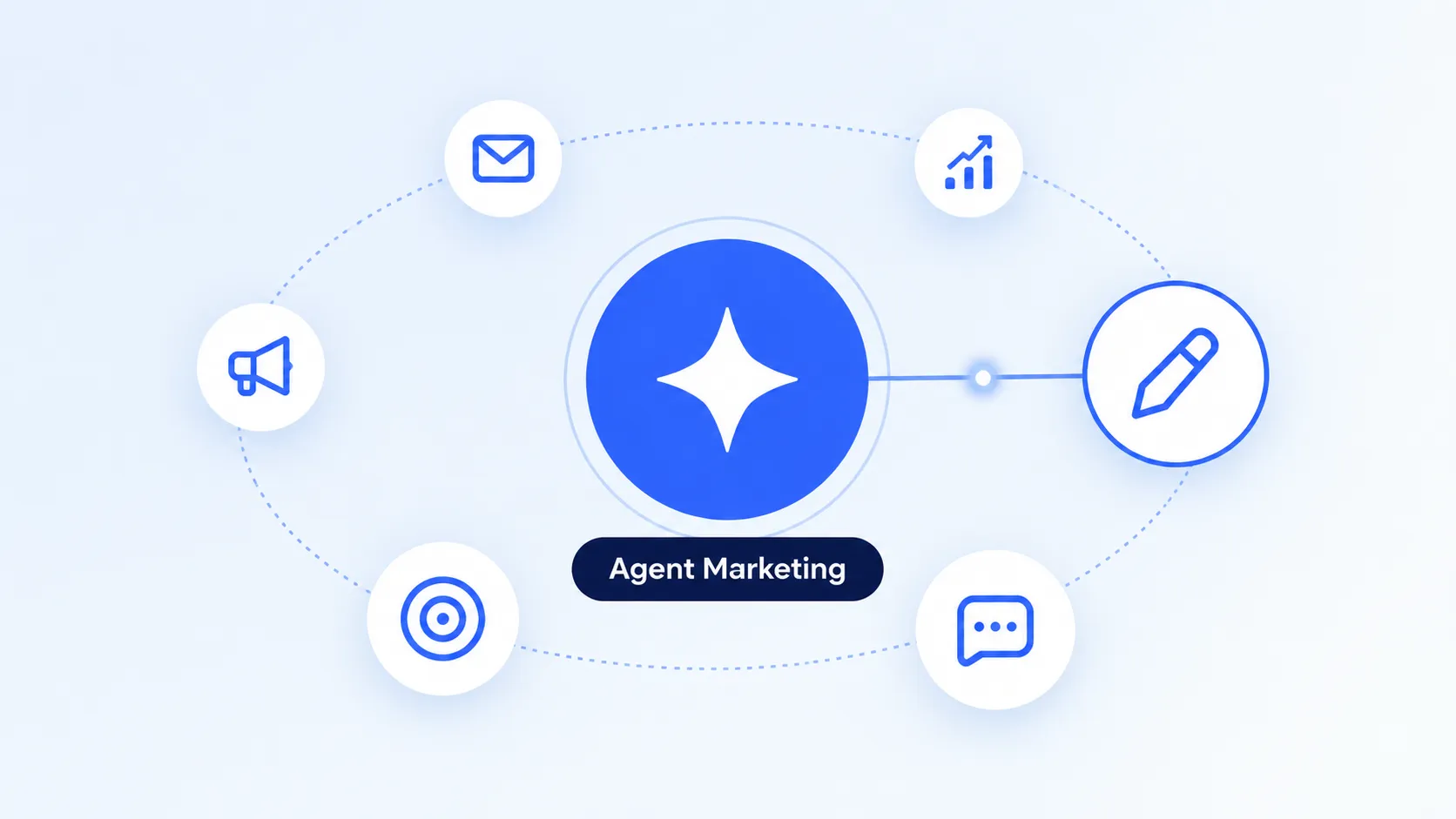
An AI marketing agent is a software worker configured for a specific marketing outcome. It receives a goal, plans the steps, uses tools to gather context, produces the asset, and checks the result against rules you set.
The typical components
- A frontier model. Claude, GPT, Gemini, or Mistral, selected per task rather than imposed globally.
- Tools. Web search, SEO data, and RAG retrieval over your own documents.
- Planning. The agent breaks a brief into steps: research, outline, draft, internal links, meta content.
- Execution. It writes and formats to a target length and structure.
- Verification. Fact-checking against retrieved sources, tone control, and terminology checks.
- Guardrails. Forbidden phrasing, legal constraints, claim limits, mandatory disclaimers.
Brand-voice training
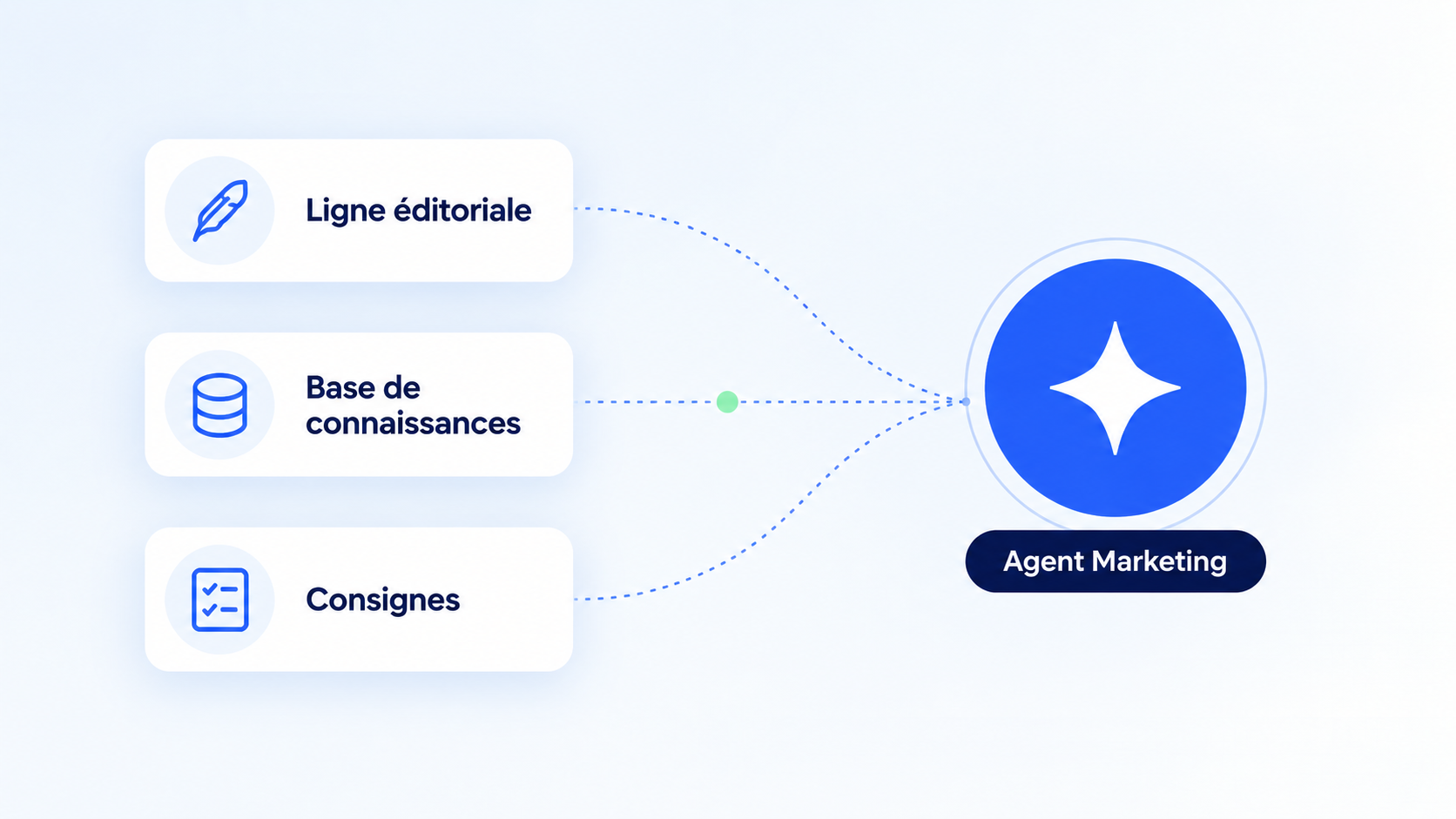
This is where quality comes from. Three inputs do most of the work.
- Editorial guidelines: tone, sentence length, banned expressions, typography, regulatory constraints.
- A knowledge base: white papers, webinar transcripts, product sheets, existing top-performing content.
- Canonical examples: three to five assets that represent exactly what “good” looks like.
Encode this once. Every agent inherits it.
Three levels of autonomy
- Prompt-level use. A person writes a prompt in a chat window. Quality depends entirely on that person.
- Co-pilot mode. The agent drafts, a marketer steers section by section. Useful for sensitive assets.
- Autonomous agents. The agent runs a full multi-step task from brief to publish-ready output, with a human approval gate at the end.
Most enterprise teams run a mix. Thought leadership stays in co-pilot mode. Volume formats go autonomous.
AI marketing agent vs. general conversational chatbot
A short example
Ask a general chatbot for a 1,500-word article on your product category. You get a competent, forgettable draft. It invents a statistic, uses a competitor's positioning language, and ignores the three claims your legal team banned last quarter.
An AI marketing agent configured for the same task pulls the statistic from your own research report, applies your terminology list, skips the banned claims, adds internal links to your pillar pages, and returns the meta title and description. One reviewer, one pass.
Six use cases that pay for themselves
1. SEO blog agent
Playbook: target keyword and SERP analysis → outline validated by the content lead → draft with internal links and metadata → fact-check against knowledge base → editor approval.
KPIs: publish-ready rate on first draft, time from brief to publication, ranked keywords per quarter.
2. Social calendar and multi-network posts
Playbook: pick the monthly theme → generate a 20-post calendar per persona → adapt hooks per network → schedule → review engagement weekly.
KPIs: posts published per month, engagement rate per persona, reply-to-impression ratio.
3. Nurture email sequences
Playbook: define the segment and the objection → map five emails to five stages → draft with one CTA each → run compliance check → push to the marketing automation platform.
KPIs: open rate, click-to-meeting rate, sequence build time.
4. Ad copy variations
Playbook: load the offer and the audience → generate 10 headline and description pairs per angle → filter on character limits and claim rules → launch a split test → keep the top three.
KPIs: CTR by variation, cost per lead, number of tested variations per month.
5. Repurposing a webinar
Playbook: ingest the transcript → extract the five strongest arguments → produce one SEO article, five LinkedIn posts, one newsletter, one video script → align all of it on the same editorial line → distribute.
KPIs: assets produced per source content, production time saved, traffic from repurposed content.
Mark AI clients report up to 85% time saved on this derivation work.
6. Multilingual localization
Playbook: approve the master asset → adapt per market with local examples and idioms → apply the country-specific glossary → local reviewer validates → publish per locale.
KPIs: languages shipped per campaign, local review turnaround, organic traffic per market.
Bonus: product launch kit
One brief produces the landing page copy, the announcement email, the sales one-pager, the FAQ, and the LinkedIn sequence. Every piece uses the same messaging hierarchy.
[Image suggestion: table or grid showing one master asset fanning out into eight derived formats]
How to implement an AI marketing agent with Mark AI
Step 1: Define objectives and KPIs
Pick three numbers. Content velocity, publish-ready rate, organic traffic. Record your baseline before you configure anything.
Step 2: Centralize your brand voice
Consolidate your style guide, tone rules, banned expressions, and terminology. Add positive examples and negative examples. Negative examples matter as much as positive ones.
Step 3: Connect your sources of truth
Upload white papers, product documentation, webinar transcripts, and your best-performing articles. Define the RAG scope per agent so a product agent does not answer with brand campaign material.
Step 4: Configure the agent
Set the role, the target persona, the instructions, the target length, and the constraints. Add guardrails for legal and compliance requirements. In regulated sectors, this step is what makes the output approvable.
Step 5: Equip the agent
Give it what it needs to work: SEO brief generation, editorial planning, templates, and CMS connectors. Mark AI ships native connectors for HubSpot, Salesforce, WordPress, Drupal, Brevo, Slack, and Google Workspace, plus a public API. Discover the Mark AI Studio.
Step 6: Design the editorial workflow
Map the chain: brief → draft → review → approval → publish → distribute. Content Factory handles the orchestration, including automatic derivation of a master asset into articles, posts, emails, and scripts.
Step 7: Set governance and quality controls
Keep a human approval gate. Require sources for every claim. Run tone and terminology checks before review. Klesia moved internal validation cycles from 15 days to 1 day with this setup. See the customer stories.
Step 8: Measure and iterate
Track KPIs monthly. Feed reviewer corrections back into the agent instructions. Retire agents that nobody uses.
Realistic expectation setting matters here. Mark AI gives you orchestration, brand consistency, integrations, guardrails, and verifiability. It does not replace editorial judgment, and it should not.
Best practices and pitfalls
Do:
- Version your agent instructions like code.
- Restrict retrieval to approved sources.
- Define autonomy boundaries per format and per risk level.
- Keep one named owner per agent.
- Review the first 20 outputs closely, then sample.
Don't:
- Ship anything with an unsourced statistic.
- Let every user create their own agent with no review.
- Use one generic agent for all formats and all personas.
- Skip the compliance rules and hope the reviewer catches everything.
- Judge the agent on its first output. Judge it after one round of instruction tuning.
Measuring performance and ROI
Track five metrics.
Across observed Mark AI deployments: 10x production speed at constant headcount, 60% lower production cost versus agency or internal-only setups, 90% time saved on validation cycles in regulated sectors, and 2 to 3 full-time equivalents freed per marketing team. ROI typically lands in month four to six.
Also count what disappears from the budget. Several LLM licenses, SEO and monitoring tools, fact-checking subscriptions, and agency derivation work often sit in the same stack today.
How to apply this today
- Audit your last 10 published assets. Note how many review cycles each one took. That number is your baseline.
- Pick one format. SEO articles or LinkedIn posts. One format, one persona, one owner.
- Write your brand voice file today. Tone, banned phrases, terminology, three model examples. Two hours of work, permanent value.
- Upload five knowledge sources. Your best white paper, two product sheets, two top-performing articles.
- Configure one agent and run three briefs through it. Compare the output to your baseline.
- Log every reviewer correction. Feed them back into the instructions after the third draft.
- Add a second agent only once the first one is trusted. Sequence beats simultaneity.
FAQ
Is an AI marketing agent only for B2B teams? No. The brand-trained agent model works in B2C too. Mark AI runs deployments with retail and fashion brands alongside B2B software and financial services.
How is this different from ChatGPT Enterprise or Copilot? Those are general-purpose tools accessed through a chat window. An AI marketing agent platform adds brand training, multi-step orchestration, SEO intelligence, martech connectivity, and approval workflows.
How long does implementation take? Two to four weeks for a first operational workspace with Mark AI. That includes agent configuration, guideline ingestion, knowledge base setup, and team training. Enterprise POCs usually run over three months.
What about data security and compliance? Mark AI hosts in France, supports SSO, isolates client data per workspace, and never uses client data to train third-party models. The CTO joins IT and security reviews directly.
Do we still need writers? Yes. The role shifts toward briefing, editorial judgment, and quality control. Teams report 2 to 3 FTE equivalents freed for strategy rather than production.
The takeaway
An AI marketing agent moves content production from a headcount problem to a software process. Same team, same brand voice, ten times the throughput, with an audit trail your compliance reviewers accept.
The teams pulling ahead are not the ones with the biggest content budgets. They are the ones who encoded their brand voice once and built a production chain around it.
Ready to see it on your own content? Request a demo of Mark AI and bring one real brief. You will leave with a publish-ready draft.

