
Also read: our GEO guide for AI engines for the foundations of generative engine optimization, and the Mark AI GEO agency for framing, production and monitoring of your AI visibility.
Your competitors show up in ChatGPT's answers. You don't. Yet your site ranks well on Google and your web content is solid. The problem lies elsewhere: artificial intelligence does not rank pages, it assembles an answer.
ChatGPT SEO follows different rules from classic SEO. It is no longer about winning a position, but about being retained as a source of truth at the moment the model writes. This shift changes your priorities: entity authority, clarity of wording, consistency across all your channels.
This article gives you the levers that are observable and publicly documented. No speculation about OpenAI's internal mechanisms. Only practices you can apply, measure and correct this very week. For the big picture across all generative engines, see our GEO guide for AI engines.
Key takeaway: ChatGPT relies on two resources: its training memory and live search. You influence the latter through your technical accessibility and the former through your repeated presence across the web. Factual, structured content attributable to a clear entity concentrates most citations.
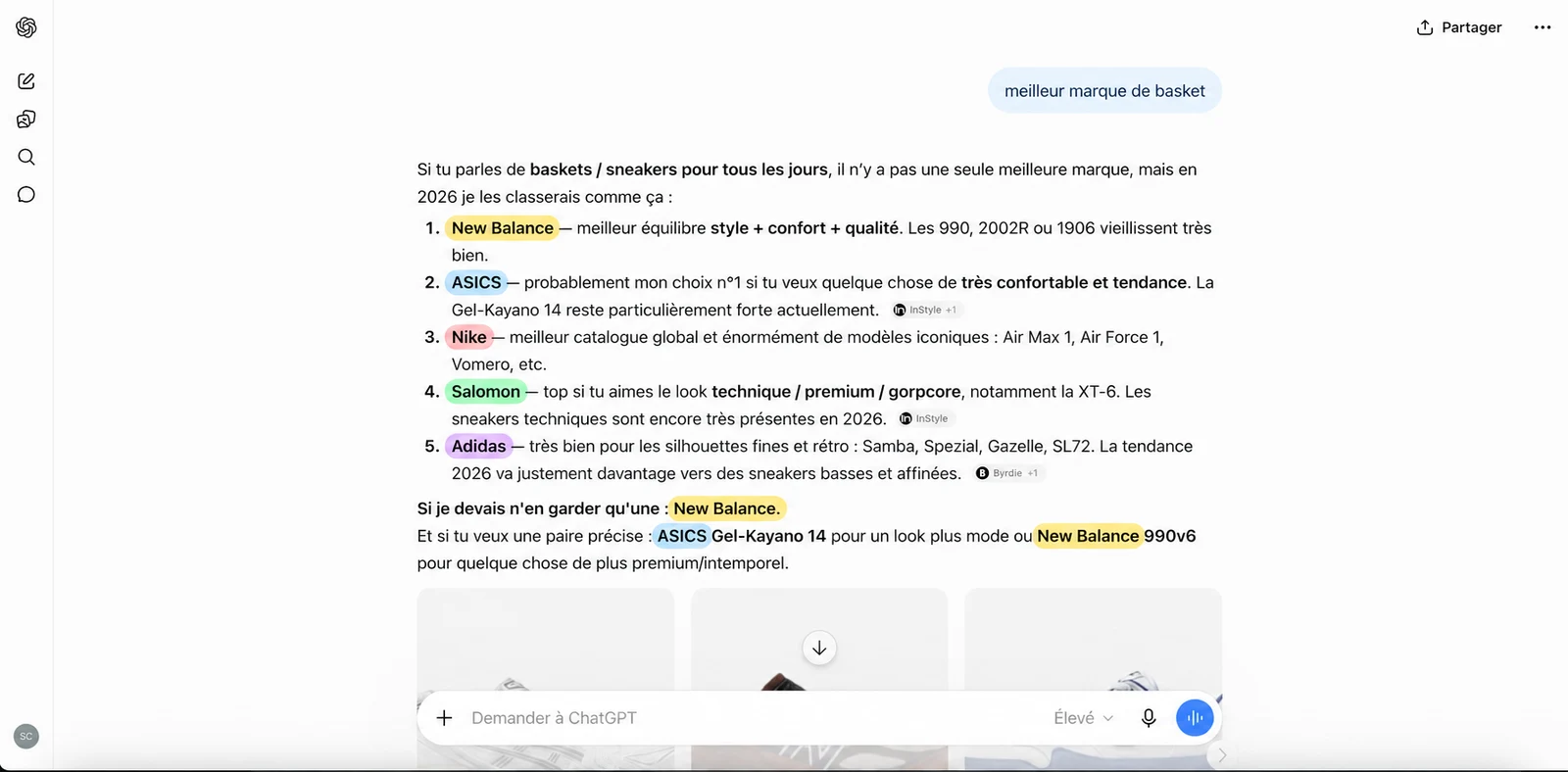
How ChatGPT builds an answer
Model memory and live search
ChatGPT operates in two modes. Without browsing, it draws on the knowledge acquired during training. Your brand appears if it was already present, mentioned and described consistently across the web.
With search enabled, the model queries a live index, notably powered by Microsoft Bing technology. It selects a few pages, extracts the useful passages, then writes a cited synthesis.
This dual mechanism explains a common phenomenon: a site invisible in Bing has little chance of being cited, even with excellent Google SEO. Your digital strategy must therefore cover both search engines.
OpenAI's crawlers
OpenAI publicly documents three distinct agents. Their roles differ, and your robots.txt file must treat them separately.
| Agent | Documented role | Recommendation |
|---|---|---|
| OAI-SearchBot | Indexing for search inside ChatGPT | Allow, essential to be cited |
| ChatGPT-User | Fetching a page at a user's request | Allow |
| GPTBot | Data collection for model training | Strategic choice depending on your licensing policy |
Blocking GPTBot protects your proprietary content from training. Blocking OAI-SearchBot simply excludes you from answers. Many companies confuse the two and make themselves invisible without meaning to.
The optimization principles that increase your citations
1. Strengthen your entity authority
Artificial intelligence reasons in entities: an organization, a product, a person. It needs to know who you are, what you do and why you are credible on a topic.
This recognition is built through consistent repetition. Same name, same description, same positioning everywhere: website, professional profiles, industry directories, business listings, Wikidata, press releases. A naming inconsistency dilutes the signal.
2. Write content that is ready to be cited
A generative model extracts self-contained passages. A sentence that fully answers a question is worth more than a brilliant paragraph that depends on its context.
Three reflexes are enough:
- Put the answer first, then develop the argument.
- Quantify systematically: volumes, percentages, durations, costs.
- Attribute every data point to a dated, verifiable source.
Industry analyses published in 2025 and 2026 converge on one point: content rich in statistics and attributed quotes is overrepresented in generative answers.
3. Structure your answers as questions
Users query ChatGPT in natural language. Your headings must reflect these real formulations.
A section titled “How much does a content orchestration platform cost?” will be mobilized more easily than an abstract heading like “Pricing”. A canonical, updated, non-duplicated FAQ page is often your most profitable asset in generative optimization.
4. Mark up with structured data
Schema.org markup guarantees no citation. It reduces ambiguity about the nature of your web content, which remains useful for any search engine.
Prioritize Organization, Article, FAQPage, Product and Breadcrumb. Add publication and update dates, along with an identified author.
5. Align website, documentation and profiles
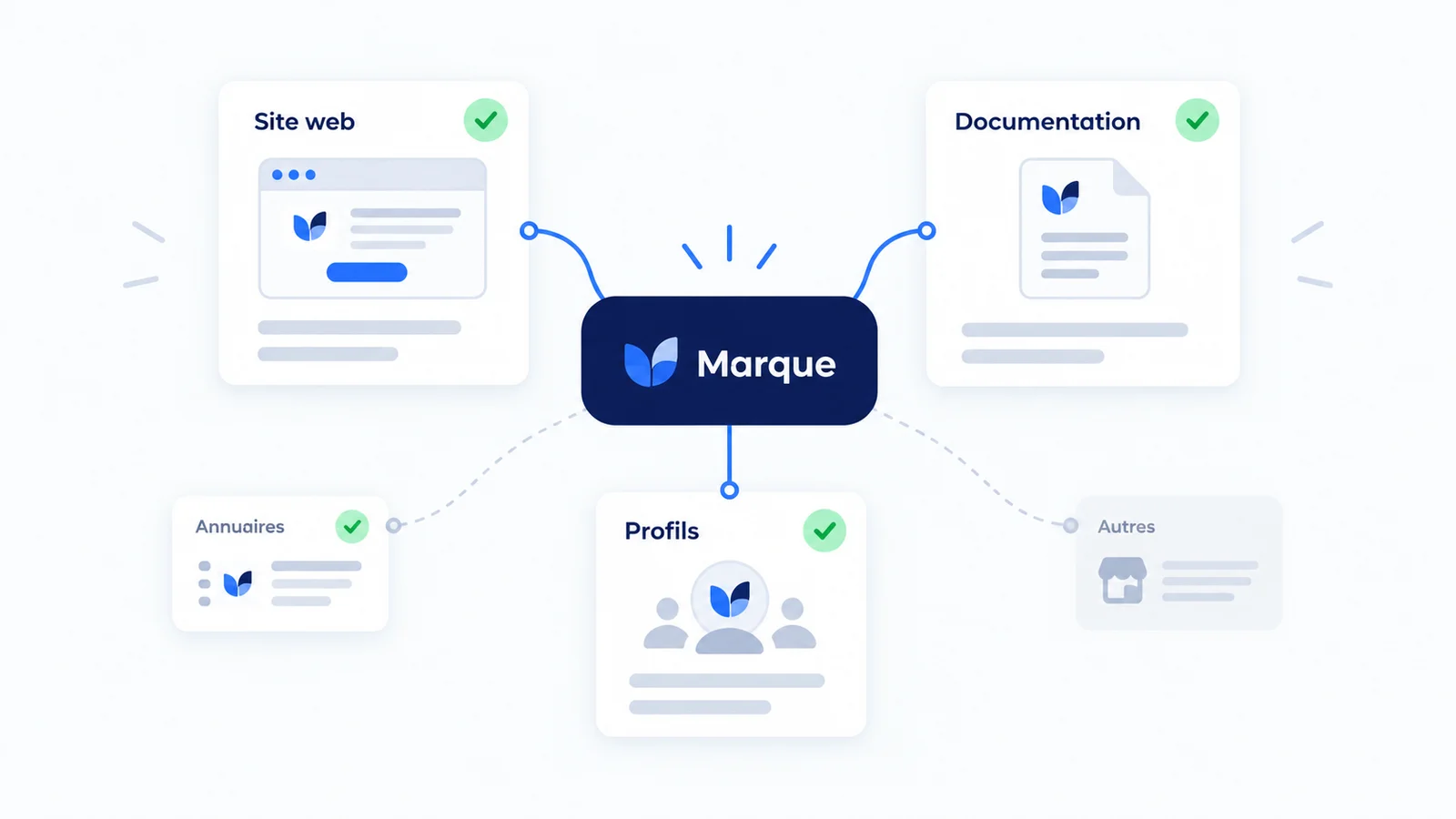
Your technical documentation, product pages and social profiles form a single corpus in the technology's eyes. A contradiction between two sources weakens your overall credibility.
Which content types generate the most citations
Not all formats are equal. Here is a summary comparison of content types and their potential for ChatGPT SEO.
| Content type | Citation potential | Production effort | Priority |
|---|---|---|---|
| Canonical FAQ pages | High | Low | Immediate |
| Proprietary data study | Very high | High | Quarterly |
| Public technical documentation | High | Medium | High |
| Neutral, sourced definition page | High | Low | Immediate |
| Industry news article | Medium | Medium | Regular |
| Promotional sales page | Low | Low | Low |
| Gated content behind a form | Very low | High | Pair with a public summary |
Proprietary studies deserve special attention. A data point only you produce becomes a unique reference. It then circulates in third-party articles, which multiplies authority signals.
The pitfalls that cost you citations
Internal duplication. Three pages addressing the same question compete with each other. The model no longer knows which one is the reference. Merge and redirect.
Unsourced marketing claims. “Market leader” with no verifiable source adds nothing. A sentence like “100 enterprise clients across 8 countries” can be quoted as is.
Fully gated content. A whitepaper locked behind a form remains invisible. Publish an 800-word public summary with the key figures, and keep the full document behind your form.
Missing dates. Content without an update date is hard to favor against a source dated last month.
Keyword stuffing. This practice degrades readability and therefore extractability. Optimizing for artificial intelligence rewards clarity.
Measure and protect your presence
No official tool provides your citation data inside ChatGPT. You therefore work with indirect signals.
| Signal to track | Method | Frequency |
|---|---|---|
| Brand citations | Typical queries tested manually or via a tracking tool | Monthly |
| Traffic from ChatGPT | Referral source analysis in your analytics tool | Weekly |
| Crawler visits | Server log analysis by agent | Monthly |
| Accuracy of claims | Checking the brand descriptions the AI returns | Monthly |
Build a basket of 20 to 30 questions representative of your market. Test them regularly, record who gets cited, spot factual errors about your brand. A wrong description is corrected by publishing a clear source page and updating your third-party profiles.
Mind compliance: this tracking must remain documentary. Do not collect any personal user data in this context, in accordance with GDPR.
How to apply this advice today
- Check your robots.txt. Allow OAI-SearchBot and ChatGPT-User. Make a conscious decision about GPTBot.
- Verify your Bing indexing. Create or check your Bing Webmaster Tools account and submit your sitemap.
- Identify your 10 strategic questions. Use your prospects' real formulations, not your internal vocabulary.
- Create a canonical FAQ page. A complete two-sentence answer per question, then the development.
- Rewrite your 5 most strategic pages. Answer at the top of each section, attributed figures, visible dates.
- Publish a proprietary figure. An internal survey, an analysis of your customer base, a price benchmark.
- Standardize your brand descriptions. Website, LinkedIn, directories, press releases: one single reference formulation.
- Set up your monthly tracking. 20 tested questions, results recorded in a shared dashboard.
[Suggested video: demonstration of testing a basket of questions and reading the cited sources]
ChatGPT SEO checklist
- OpenAI crawlers correctly configured
- Site indexed in Bing and Google
- One single reference page per strategic question
- Direct answer placed at the start of each section
- Quantified data with source and date
- Organization, Article and FAQPage markup in place
- Identified author with proof of expertise
- Consistent brand descriptions across all channels
- Public summary available for every gated asset
- Documented monthly citation tracking
Move from visibility to designation
ChatGPT SEO rewards companies that publish verifiable, structured and consistent information. This requirement matches that of SEO, with one additional constraint: every passage must work on its own, out of context.
The difficulty lies in volume. Covering 200 questions on your market, in several languages, with a constant editorial line, exceeds the capacity of a classic marketing team. That is precisely the role of an industrialized production chain, where specialized agents produce the canonical content, the public summaries and the per-market variations.
How many of your strategic answers exist today as a canonical, dated, sourced page? Do the count this week. To structure your approach with dedicated support, discover the Mark AI GEO Agency.

